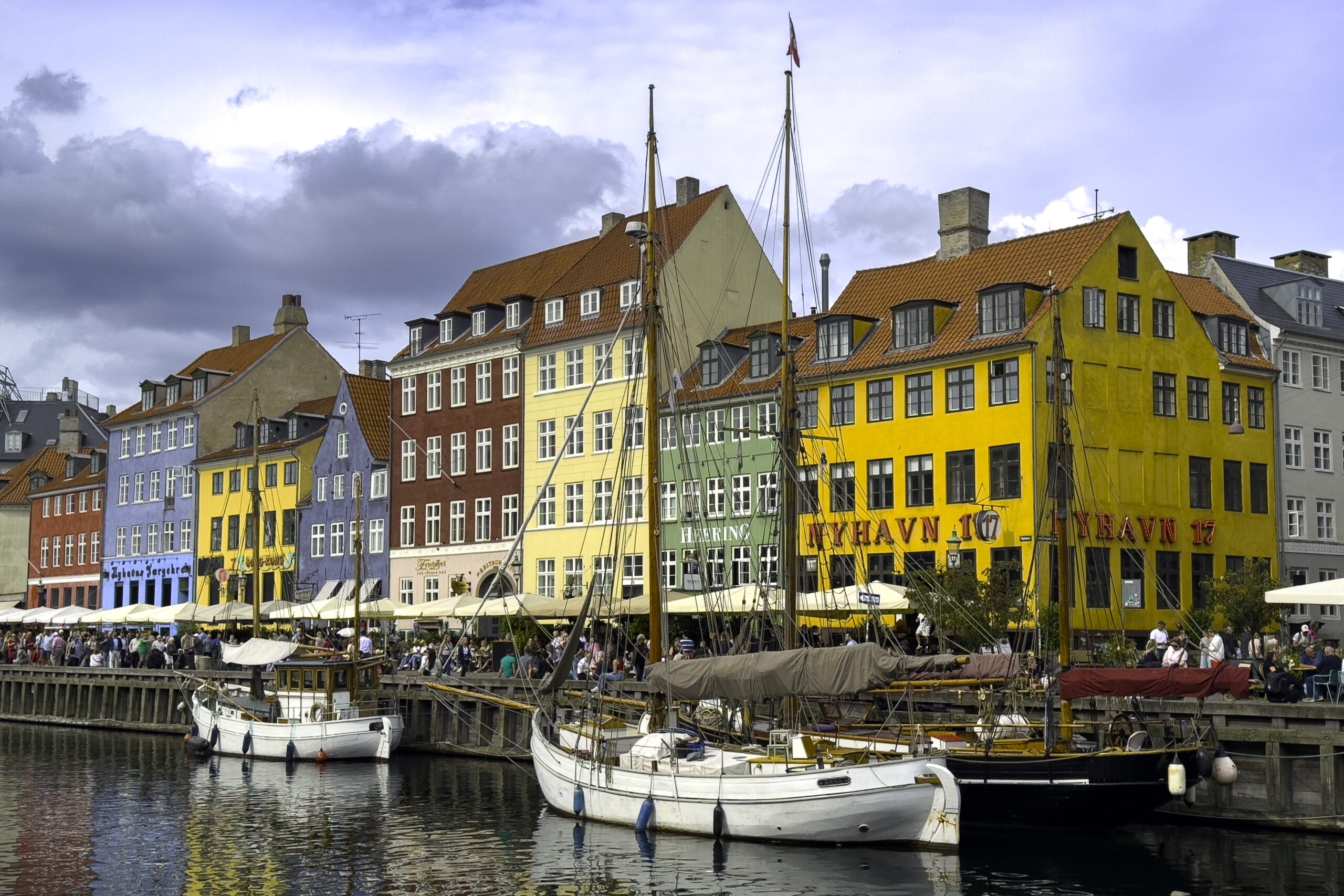
Copenhagen rewards slow exploration. Over a week, we walked much of the city, tracing cobbled streets and leafy boulevards, and occasionally joined the Danes on two wheels using bike-sharing apps. Along the way, we savored world-class bakeries, dined at both bold New Nordic and playful fusion tables, immersed ourselves in contemporary art, admired centuries of architecture, and discovered how beautifully designed urban spaces shape everyday life.

Daily Rituals at the Bakery
If Paris has patisseries, Copenhagen has its bagerier, and each one tells a story. Sankt Peders Bakery, founded in 1652, is the city’s oldest and still handcrafts pastries from time-worn recipes; eating a cinnamon bun outside the 15th-century Sankt Petri Church felt like tasting history. Hart Bageri, created by Richard Hart after his success at San Francisco’s Tartine, quickly became a global icon. When Hart relocated to Copenhagen, he partnered with Noma, which wanted his bread for its own service. That endorsement immediately placed Hart Bageri on the world stage, and today its cardamom buns and tebirkes are citywide legends, each layer a balance of buttery richness and Nordic restraint. Juno the Bakery in Østerbro, founded by former Noma pastry chef Emil Glaser, draws long morning queues for cardamom and vanilla buns that balance elegance and comfort. Their tins of butter cookies, a refined take on a Danish classic, are just as special and worth buying to enjoy later or bring home as edible souvenirs. At Andersen & Maillard, a chocolate-cream “muffin croissant” shows how Danish technique meets playful reinvention. Lille in Refshaleøen offered us a blomster bun scented with dried flowers, an example of how bakers experiment within tradition. In this city, bakeries are not only breakfast but also living workshops of craft, reinvention, and global influence.

Dining at Every Scale
Copenhagen’s dining scene is as adventurous as its design. At Sanchez, Rosio Sanchez, formerly pastry chef at Noma, blends Mexican tradition with Scandinavian produce in a way that feels both rooted and innovative. The restaurant has earned recognition from Michelin for its imaginative combinations, where heirloom corn meets Danish sea buckthorn or local cheese. The result is food that tells a story of both migration and place.
Popl is another child of Noma, born from a pandemic pop-up when the team sought to create something more approachable than fine dining. It quickly became a permanent restaurant, known for burgers that elevate simple comfort food through careful sourcing and thoughtful preparation. A meal here shows how Copenhagen’s chefs blur the line between casual and exceptional.
Geranium sits at the very peak of the dining world. Led by chef Rasmus Kofoed, it holds three Michelin stars and has been ranked the best restaurant in the world. Meals unfold over 13 courses, with each dish rooted in New Nordic philosophy, guided by seasonal ingredients, and plated with artistic precision. Dining here feels like stepping into an edible landscape, where sea, forest, and field are distilled into unforgettable flavors and forms.
Not every remarkable meal requires white tablecloths. At Torvehallerne, the city’s famous glass-covered market, we discovered Hallernes Smørrebrød. The open-faced sandwiches (smørrebrød), layered with smoked salmon, plaice fillet, remoulade, or trout roe, are a Danish classic elevated by freshness and attention to detail. We also made time for Reffen, the city’s largest street food market, built on a redeveloped industrial site. With stalls spanning global cuisines, the market embodies Copenhagen’s creativity and international outlook. It is also the perfect place to try a classic Danish hot dog, complete with remoulade, mustard, ketchup, fried onions, and pickles, eaten while overlooking the harbor. From Michelin stars to street food, dining in Copenhagen is as much about curiosity and storytelling as it is about taste.


Immersed in Art & Design
Copenhagen’s art spaces often blur the line between environment and exhibition. Cisternerne, an underground reservoir from the 1850s originally built to secure the city’s water supply, now stages contemporary art beneath dripping stalactites and echoing vaults. The damp, cave-like setting makes each installation inseparable from its architecture, turning every exhibition into a dialogue with the space itself. During our visit, the exhibition Psychosphere by Jakob Kudsk Steensen transformed the chambers into a volcanic undersea world of fossils, imagined hybrid creatures, and shifting light, a haunting meditation on evolution and ecology. Copenhagen Contemporary, located in a former shipyard hall, presented Soft Robots, where artists explored humanity’s uneasy relationship with artificial intelligence and identity. The Louisiana Museum of Modern Art in Humlebæk, perched above the Øresund since 1958, balanced outdoor sculpture gardens by Calder and Moore with immersive installations by Yayoi Kusama. Back in the city, Designmuseum Danmark showcased the enduring influence of Hans Wegner, Arne Jacobsen, and Finn Juhl, whose chairs once seemed radical and now feel timeless. Even passing the closed doors of Tom Rossau’s atelier, we were reminded how Danish design weaves light, wood, and form into everyday life.


Walking Through History
Copenhagen’s streets reveal their history layer by layer. The Round Tower, completed in 1642 for King Christian IV, is Europe’s oldest observatory. Its most striking feature is the wide spiral ramp, once used by horses to haul heavy equipment and now climbed by visitors for sweeping views of the city’s rooftops and spires. Christiansborg Palace, home to Denmark’s Parliament, Supreme Court, and royal receptions, rises from centuries of rebuilding. Fires destroyed earlier castles on the site, leaving behind ruins that can still be seen beneath the current palace, a reminder of both destruction and resilience.
The city’s churches capture shifts in style and belief. Trinitatis Church, built in the 17th century, combined worship with university life, a reflection of the era’s union of faith and learning. Grundtvigs Kirke, completed in 1940, is unlike anything else in the city: its pale yellow brick and towering, organ-shaped façade merge Gothic tradition with Expressionist modernism. Our Savior’s Church in Christianshavn, with its golden spiral staircase climbing dramatically around the exterior, remains one of Copenhagen’s most recognizable landmarks.
Even ordinary neighborhoods hold echoes of history. In the Meatpacking District, faint Nazi etchings carved into brick during World War II remain unsettling reminders of occupation. In Christiania, the self-declared autonomous community founded in 1971, residents recently voted to close Pusher Street, long notorious for open cannabis trade. That act of reclaiming the street underscored how history here is never static. It is lived, debated, and reshaped in public view.


Parks, Public Spaces, and Everyday Life
In Copenhagen, green spaces are not simply escapes from the city but essential parts of civic life. Frederiksberg Have, created in the 1700s in the style of an English landscape garden, surrounds Frederiksberg Palace with rolling meadows, shaded grottos, and quiet lakes where visitors still row boats in summer. It was once the private retreat of kings and today serves as a democratic commons for families, picnickers, and birdwatchers alike.
Assistens Cemetery tells a different kind of story. Established in 1760, it is the final resting place of Hans Christian Andersen and Søren Kierkegaard, along with many other Danish luminaries. Yet it is also a beloved neighborhood park. Joggers trace its tree-lined paths, parents push strollers past weathered headstones, and cyclists use its lanes as a shortcut. It is at once a place of remembrance and of daily life, a rare blending of reverence and recreation.
Superkilen Park in Nørrebro celebrates Copenhagen’s diversity in exuberant fashion. Developed with input from local immigrant communities, it gathers more than one hundred objects from around the world, from Moroccan fountains to Russian benches to a Thai boxing ring. Each artifact is set within a bold landscape of red plazas, black pathways, and green hills, transforming what was once a troubled district into a vibrant symbol of multicultural identity.
And Tivoli Gardens, enchanting visitors since 1843, remains one of the city’s most beloved landmarks. Its ornate gardens, nostalgic amusement rides, open-air concerts, and indulgent pastries at Cakenhagen create an atmosphere that is both timeless and playful. Walt Disney famously drew inspiration here, and the park still feels like a living fairytale in the heart of the city.
Together these spaces show that in Copenhagen, parks are not decorative extras. They are woven into the fabric of urban life, functioning as gardens, playgrounds, gathering places, and cultural stages all at once.


Biking, Boating, and Sustainable Futures
To truly experience Copenhagen, we moved as the locals do. On rented bikes we joined the morning tide of commuters, pedaling through a city designed with cyclists in mind. Wide lanes, clear signals, and bridges dedicated to bicycles made the rhythm of traffic feel like choreography. When our legs tired, the city’s public transit carried us seamlessly from neighborhood to neighborhood, linking metro, train, and bus into a network that felt both intuitive and efficient.
Seeing the city by water added yet another perspective. On a Stromma canal tour we glided past floating houseboats in Refshaleøen, Bjarke Ingels’s experimental Urban Rigger student housing made from shipping containers, and the vast copper dome of Frederik’s Church, finally completed in 1894 after more than a century of delay. We also spent an afternoon at CopenHot, which is located on Copenhagen’s industrial harbor at Refshaleøen. CopenHot offers New Nordic wellness with fire-heated hot tubs and saunas overlooking the water, is almost 100 % CO₂-neutral, and has anchored the city’s outdoor spa scene for about a decade.
Copenhagen also shows how infrastructure can be playful as well as practical. CopenHill, a waste-to-energy plant that powers thousands of homes, doubles as a ski slope, climbing wall, and hiking trail. Olafur Eliasson’s Circle Bridge encourages pedestrians and cyclists to pause, its overlapping circular platforms turning a crossing into a place of lingering. Even new housing on Paper Island honors the city’s past with façades inspired by historic warehouses, while creating public halls at the waterfront and rooftop gardens for its residents.
For visitors, the Copenhagen Card made navigating all of this simpler, offering unlimited access to public transit and entry to many cultural sites. More than just a convenience, it allowed us to experience the city as Copenhageners do, moving easily from one district to another. Here, infrastructure is not only engineered for efficiency but also designed to bring joy, connection, and a sense of community.


Conclusion: A City That Designs for Living
A week in Copenhagen left us nourished by food, by art, design, and architecture, and by the sheer pleasure of moving through humane spaces. Bakeries became our morning rituals, design revealed itself as a civic language, and parks felt like extensions of home. Historic churches and modern museums stood side by side with bike lanes, harbor baths, and inventive housing, woven into a fabric that feels deeply Danish yet welcomingly global.
The Copenhagen Card made moving through this fabric effortless, giving us unlimited access to public transit and admission to many of the city’s cultural landmarks. It allowed us to step easily from one district to the next, to combine boat rides with museum visits, and to fully experience the city.
Time seemed to slow here, and in that slowing, every pastry, every bike ride, and every quiet bench along a canal became part of Copenhagen’s larger lesson: that beauty, sustainability, and community are best when shared.


